


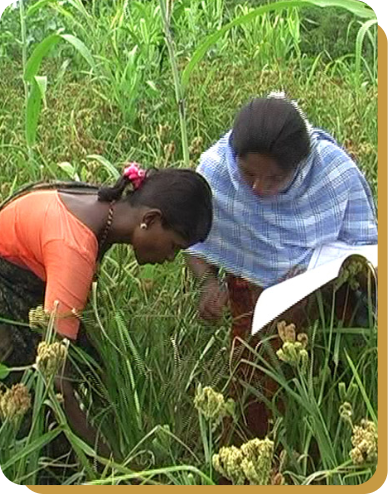
Our work to empower the small scale and marginal farmers of India first began in 1994 with a simple effort to distribute indigenous seed varieties in and around the village of Thalli, Tamil Nadu. This soon turned into a growing biodiversity conservation programme which is central to our work ever since.
Side by side with farmers, a lot of research was conducted in the initial years to understand the various characteristics of indigenous seed varieties. Close to a 100 different varieties of minor millets, dry land paddy and oil seeds were tracked down and brought back to the farm at Thalli for further experimentation. Within a period of 3 years, the number of farmers we reached out to had increased from 5 to 105.
THE FOUNDATION (1994-2016): Seeds as Heritage
We began with a simple recognition: India's agricultural biodiversity was disappearing. Farmers were losing access to the seeds their ancestors had saved for generations. We established community seed banks not just to preserve varieties, but to keep them in farmers' hands and fields.
THE EVOLUTION (2017-2025): Seeds as Systems
Over time, we learned that conserving seeds wasn't enough. Farmers needed integrated support - ecological farming knowledge, soil health practices, pest management alternatives, certification systems, market connections, and consumer awareness. We evolved from seed conservation to regenerative agriculture systems, building the enabling environment across policy and markets.
THE TRANSFORMATION (2025-2035): Systems as Solutions
Today, we understand our work differently. We're not just helping farmers - we're demonstrating how regenerative food systems can address interconnected crises of climate, nutrition, and rural livelihoods by transforming policy frameworks, market systems, and investment flows. Agrobiodiversity isn't nostalgia; it's climate infrastructure. Farmer knowledge isn't tradition; it's innovation. Consumer awareness isn't marketing; it's food citizenship. Market transformation isn't compromise; it's rewarding stewardship. Our field experience becomes evidence for policy. Our local models become blueprints for transformation. Our farmer collectives become investment opportunities. Our consumer networks become market drivers.
Get in Touch
Email:
[email protected]Registered Office
#36, Vinayaka Layout, Bhoopasandra Main Road, Bhoopasandra, Bangalore – 560094
Connect